Thursday, May 24, 2018

Bob WL7GK SK

Just two days ago a number of hams and many others bid farewell to Bob Kreiser obituary. WL7GK was the raspy voice of Interior Alaska. Bob could be found as a regular on the Alaska HF nets and the repeaters. He loved to drive and motored with ham radio extensively, once even calling for emergency services to a bad wreck on an extremely remote part of the Alaska Highway. Bob could, and often did, break anything electronic. Still, his disasters brought learning experiences for all involved. Friendships were cinched.

Bob was not a contester, but he encouraged KL2R's evolution and had a few chances to operate from here. His own city location was plagued with noise. Bob was always among the first to volunteer for public service events and emergencies. He regularly pulled the overnight shift for Skywarn Recognition Day from KL7FWX, and he was a force behind several recent Field Day efforts under the KL7KC banner. He hated CW. His final gift to me was a Vibroplex Deluxe singler-lever paddle ca. 1975. In pieces.

WL7GK was a complex character. He was gruff. And loud. And very welcoming to honest, good-intentioned folk. His love of ham radio never wavered. I watched him come to terms with the end of his radio days. My heart broke. He did not linger long after. I can say he made the most of his time on earth in the 20 years I knew him. Godspeed, Senior Chief, and 73!


Monday, February 12, 2018

Off With a Bang

As promised, KL2R is starting 2018 with great gusto. Several contests have helped the count, but so has the International Grid Chase and a quest for Worked All States on 80 meters, which will also give us 5BWAS. That means we're reasonably active shooting grey line to DX in the morning and evening. Europe, JA, VK, and North/South America are proving to be very workable on FT-8, when openings can be very brief (minutes), but long enough for the new mode. As of this date, we have 40 LoTW QSLs on 80 WAS, and 21 DXCC. A highlight was working Francesco IK0XBX after trying for about three weeks.

This brings me to WPX RTTY last weekend, which was a big blast. Saturday was busy in the shack. Dan KL1JP stopped by late morning and proceeded to spend several hours running on 20 meters, picking up on an early opening that really didn't abate until mid-afternoon. At that time John AL7ID, Paul KL4ET, and Pete KL4IT arrived for a demonstration and tutorial. It was a good time to give the latter two an intro to the shack, as we switched to 40 and 80 meters and the rates slowed down. Pete is a newbie to contesting, but Paul had some experience with WL7F/KL4SD SK running low power. In the end, 900 QSOs and 907k points was more than double the previous best from KL2R.

KL1JP in the middle of a six-hour 20m run for WPX RTTY.

Tuesday, January 2, 2018

What Happened in 2017?

I have to say that the past year has been nothing to shout about, at least as far as signals from KL2R have been concerned. Re-cabling in the shack and building a solid SO2R with new hardware from Microham basically came to a screeching halt. Contest opportunities and team members dried up, life basically getting in the way of a hobby.

The results are clear from log statistics from 2017 thanks to Clublog.
It is the lowest QSO count in a decade. The only year lower was 2006. We only formed the Two Rivers Contest Club in the fall of that year! So we go down in 2017 as not a failure but rather a station in transition. The to-do list is substantial, but so is the commitment to get it done in 2018.

Thursday, November 30, 2017

In Memoriam: WL7F SK

Just before Thanksgiving, Wes Jennings WL7F, age 52, was killed when his snow machine was struck by an SUV near his home on the Parks Highway about 25 miles west of Fairbanks. The contest community has lost a good one. Wes could be a royal PITA, but I admired his energy and tenacity. He was brilliant and quickly leveraged his prime RF location into a top contest spot. Off grid. Low power. He took many risks, from free-climbing his tower in the middle of winter to the accident that killed him. He was a wild man, and I shall miss him immensely.

http://www.blanchardfamilyfuneralhome.com/notices/Wesley-Jennings

Sunday, October 8, 2017

Field Day 2017

Naturally, FD propagation conditions were not very good, but that didn't stop an intrepid dozen from setting up and giving it ago under the KL2R banner. (KL7CDA was the GOTA station.) We picked a new venue at the Pleasant Valley Community Center, which is just about 7 miles east of the club station. Many thanks to John AL7ID for arranging to have the building during the weekend. Although a tri-bander was erected, only 20m proved workable. Dale KL7R rocked satellites handing out AK for a lucky few. The 6m setup really didn't prove helpful, but it wasn't for lack of trying.  Many locals are on 6m FM now.


KL7R supervises tri-bander assembly.

WL7CW tweaks and cinches.

Oh, the joy!

KL7CDA GOTA: KL4HT, two visitors from MD (ham calls missing) , KL7B, and KL1JP.


Saturday, October 7, 2017

Busy Bobcat

The tower is approximately 100 feet from the shack, and for years the cabling was only half-buried and subject to breakage. We also host the local wireless ISP equipment on the tower.  A snowplow snagged the internet cable and a coax in January. Laying new cable in thigh-deep snow at 30 below is not a great thing to be doing. A plan was thus hatched with the ISP owner to properly trench between the tower and shack just after Field Day. He has some dandy toys, not the least of which is a Bobcat skidsteer with proper attachments.  It was a 14-hour day, but conduit and spare underground cables were the result.


Time Flies Like a Banana Peel

Seriously, the time has slipped past way too easily since the last blog post in March. Here we are in early October, and one might think there has been almost no radio action since then.  Well,, nearly, but not quite.  Here's part one of the re-cap:

Visalia DX Convention

This was a riot, although a smaller gathering than in 2016, which was some kind of record. Without checking official numbers, I heard roughly 750 people attended this year. Last year it was closer to 900-1000. In spite of having a bout of flu, I attended more technical and contesting-oriented sessions. IMHO the DXpedition sessions become incredibly redundant: "It was hard. We made lots of contacts. Send money."  But I digress. See what you missed: IDXC 2017 Program. The dinner was well-attended, and many laughs were had, both intentional and unintentional. Our table mates were from Canada (VE3CFK and XYL), Colorado (N7VZ and W7UM), and Colombia (HK3W). Fun!


Saturday, March 11, 2017

Propagation Sanity Check

This morning we received an email from Finland!  It's always nice to hear from our "neighbors" across the north pole.  I know we share a common bond when it comes to tough propagation.

Hello, Sirs.
It is quite foolish to ignore JT65 spotter on.
The whole of Europe called on you.

None of the answer does not come from there.

OH4SS, Matti

I was certainly sorry to miss the opening.  

So it would seem Matti is implying one shouldn't run JT65 spots to PSK Reporter if not in the shack. Now that's an interesting point of view, and one I haven't encountered before.  I think we have a little disagreement here with Matti, but maybe there are others out there who feel the same way. 

"Foolish"?  Let me explain my rationale.

Followers of the blog -- are there any? -- will know there are special challenges the ionosphere lays on us in the high latitudes.  What they teach you in radio school about propagation being basically reciprocal is total nonsense above 60 degrees or so.  It's actually hard to figure out when openings may occur.  The second element to this puzzle besides geomagnetic instabilities is the rapidly changing daylight in the Far North.  In Fairbanks, daylight changes 6-7 minutes per day throughout much of the year.  That has huge implications for HF, as one week is literally completely different from the next.

Sooooo...here at KL2R we make frequent use of spotting software and other tools to monitor the bands. That includes CW Skimmer reporting to RBN and WSJT-X reporting to PSK Reporter.  The data is helpful to other hams who are anxious to see when the bands are open to Alaska.  What's not to like?

The other reason we frequently run receivers and spotting software when the shack is unattended is to gather data for serious technical analyses.  The data sets are useful for comparing station performance, for instance.  JT65 actually yields quantitative results on received signal-to-noise ratios from various locations.  We can compare, say, AL7ID just a few miles away.  Even better, years of study have clearly demonstrated the myth of reciprocal propagation.  Approximately 80% of the time, the KL2R signal SNR will be about 6-10 dB worse at the remote station than received here.  What that means in practical terms is that when we receive JT65 at around -15 dB (good by most standards), the other station is likely to receive us at very marginal levels, if at all.  So there you have it.

Finally, let me just say presence on PSK Reporter is not the same as a call for CQ.  The spotting network does not substitute for actual RF.  So who's "foolish"?  I suggest those who would call a station without hearing their signal.  Whatever the mode, many Europeans have a bad habit of throwing out their callsign into the ether in the hopes the DX will log them, like a message in a bottle. It's remarkable that within hours of working a pileup I will get requests by email, like "Please tell me if I worked you."  Seriously?  If I worked you, you would know it.

Friday, March 3, 2017

Experience with SDRs

A couple of years ago, N1TX was sufficiently impressed with the QST review of the FiFi SDR from Germany to order a kit and put it together.  After experimenting with it as a standalone receiver, an RF Space IF-2000 board was added to one of the FT950s.  The FiFi then became an integral part of operations, providing bandscope functions and feeding VE3NEA's CW Skimmer.  HDSDR was used to drive the FiFi, and HDSDR was kept in sync with the logging and CAT software through Omnirig.  It proved very effective, and a second FiFi was added to the FTdx-5000MP.  No interface board is required, since the FT5k radio has an IF output port.  The guidance provided by G4ZFQ was invaluable to setting everything up.

The FiFi is a "sound card" SDR and a good entry-level package.

Of course, while the FiFi, SDR-Play,  Soft Rock, and others like it are somewhat plug-n-play, soundcard-type SDRs have inherent limitations due to the way frequency conversion and filtering are implemented.  Note I said "somewhat plug-n-play".  The need to tweak multiple parameters to derive optimal performance and calibration can be a pain.  

Enter Brad Forker KC7JLU, who contacted us in 2016 to discuss installing a remote SDR in Fairbanks.  I was intrigued by a system set up so anyone in the world could tune in to the Alaska receiver via the internet and sdranywhere.com. Soon the CloudIQ was delivered from RF Space and connected to the KL2R antennas.   

The stand-alone “Cloud” mode includes a built-in internet server. In this mode, the radio performs the tuning and demodulation of signals and transmits the demodulated information back to a PC, OS-X, Linux or Android client anywhere in the world.  Control, display, and audio information can be supported over a modest internet connection.  There were few issues with streaming and control, which was used to great success during KL7FWX Skywarn on-air activities in December.  Lower noise levels and better antennas at KL2R yielded positive results. Download the RemoteSDR client to listen. Note: The unit is now on an amplified loop antenna at WL7CW's hilltop location.

A few brief experiments with the SDR in IQ mode were very convincing.  In this mode, the CloudIQ streams raw 24-bit IQ data at 1.8 MHz to software like SpectraVue running on a machine on your LAN.  Wired and wireless rates are sufficient, but streaming this amount of data over the internet may not succeed. (Hence, the Cloud mode).  However, run on the local network as either a stand-alone receiver or IF receiver, CloudIQ adds some powerful capabilities.  Having a completely independent, wideband receiver in the shack is advantageous.  Driving a radio these days without a bandscope is like flying blind.  Spectravue also allows for synchronization to a local PC-controlled transceiver for true point-and-click ability to select frequency, bandwidth, and mode settings.  We added a second CloudIQ to the FTdx5000 as an IF receiver.  It works great with the FT950 + IF-2000 as well.

One thing not tested yet with the CloudIQ is CW Skimmer.  The FiFi feeds IQ data via HDSDR into a VB-Audio virtual audio cable "connected" to the skimmer for monitoring 24 kHz bandwidth.  It is not clear from brief internet searches how to feed IQ data from CloudIQ.  Another concern is whether or not it is possible to maintain the SpectraVue bandscope function with point-and-click tuning while operating in skimmer mode due to port limitations and conflicts.  Even without CW Skimmer, it's a nice asset during the contests.


Wednesday, February 22, 2017

A new KL7 QRP Record


Where Have All the Signals Gone?

One of the main reasons you haven't heard KL2R much lately is the totally abysmal propagation plaguing us at the high latitudes for months and months.  That coupled with a short summer filled with rain, which hindered any attempt to do major station work outdoors.  There's still that other tri-bander to get up, a 160 vertical to repair, and 80m vertical system...Oh, and WARC antennas to build. And to boot, we're engaged with the North Pole Contest Group to keep KL7RA on the air, plus upgrades.  We've made a few appearances in CW and RTTY contests this winter, but all in all, activity has been very limited.

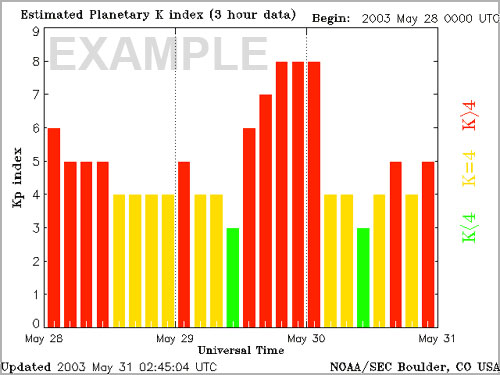
So let's have a look at a few factors influencing our ability to reach out from the high latitudes. According to my observations in nearly 20 years in Fairbanks. geomagnetic instability results in horribly fickle radio conditions.  The planetary K index (Kp) is used to characterize the magnitude of geomagnetic storms. It is measured on a scale of 0 to 9.  K-indices of 5 or higher indicate "storm-level" geomagnetic activity. Values of 7 or higher indicate a severe geomagnetic storm.  However, when Kp > 3, we at 65 degrees north have one heck of a time getting out.  We hear stations, but they often do not hear us.  This is particularly true on 20-10 meters.  The turbulence in the ionosphere will open the window for a couple of minutes and then shut for many more.  On 80 and 160, a Kp of 1 or 0 is acceptable, although such conditions are very rare.  The ups and downs are frustrating to say the least.  Nevertheless, it teaches patience.  The effects are less severe at lower latitudes, even in Anchorage or Kenai, which are near 61 degrees north.


When the aurora kicks up, which is associated with a high Kp, absorption is obviously the problem. We can often work stations within the auroral oval; e..g, UA0 or Scandinavia, but getting to W7 is problematic.

A lot of hams religiously watch the planetary A index, or Ap.  The Ap is a measure of the general level of geomagnetic activity over the globe for a given day. A mean, 3-hourly “equivalent amplitude” of magnetic activity based on K index data is computed from 11 Northern and 2 Southern Hemisphere magnetic observatories between the geomagnetic latitudes of 46 and 63 degrees.  For that reason -- the limit of 63 degrees -- the Ap is less applicable to Fairbanks at 65.5 north geomagnetic.  Even better, data from the College, Alaska, observatory are good real-time indicators of conditions.  See plots at the feed for the College Observatory (CMO).  If you are wondering where Alaska is in the contest, you might have a look at this and NOAA's Space Weather Prediction Center, which has an excellent dashboard for radio users.  Visit https://www.swpc.noaa.gov/communities/radio-communications


Saturday, May 7, 2016

The Bucket List

In mid-April I ticked off two items on my bucket list.  First, I had business meetings at the Institute for Telecommunication Sciences, the stuff of dreams for me as a lifelong radio geek.   The cavernous Building 1 at the Boulder, Colorado, complex has that true science lab feel with long hallways of cinder block and grey metal desks from a bygone era tucked in the countless offices.  Book shelves lined with Old School references and unique textbooks wound around the virtual boundaries of personal spaces.  That unique, musty aroma of old government buildings permeates the atmosphere. The place just smells like genius.  The fundamentals of radio science have been discovered and explored here for decades.  (Its organizational predecessor, the Radio Section of the National Bureau of Standards, was founded before World War I.) The trip was capped with a trip to Table Mountain, one of two radio-quiet areas in the US. Ancient antenna dishes stand out like monuments on the prairie.  It is a special place for an RF guy like myself.

For many years I had pondered going to the Visalia DX Convention.  Last summer I determined to finally make an appearance.  I flew from Denver to Fresno (via Seattle and San Diego!), where Ken W6HF and Luci KL1WE met me.  We settled in a Tulare hotel a mere 20 minutes from the Visalia Convention Center.  One of the most remarkable things about ham radio is that faceless connections you make with people are almost indelible through the years.  Finally connecting with the people behind the signals was hugely satisfying, and of course seeing again a number of industry folks for the first time in the 25+ years since I worked at 73 Amateur Radio magazine was a real hoot.

At least among the contesters, the KL2R badge caught immediate attention.  They knew the call well. I was struck, however, by the number of people who came up to me and started the conversation with something like, "So do you really live in Alaska, or do you just have a KL call?"  To begin talking with a stranger like that implies a lot of cynicism.  I guess they've been duped in the past, excited to work a KL only to find soon after the operator lives in the Lower 48, but still...

In the end, I was sorry I had not attended before.  The friendships made, renewed, and cinched up enriched me more than I could have imagined.  If any of you are reading this blog, THANK YOU!  I hope to see you again next year.

Tuesday, April 5, 2016

Final Fling with KL7RA

All credits to Wigi AL7IF and Rich's XYL Jyl for supporting one last hoorah for KL7RA on the air.  

The team converged on Kenai on Good Friday from literally around the globe.  Ed K3PN flew in from South Africa via Denver, in a blizzard.  Others converged from points around Alaska to re-connect, make new friendships, and memorialize Rich in the best possible way.   Wigi and Angela came down from Anchorage several days before to prepare.  The Kenai crew of AL2F, KL2HD, and KL8X were there for the duration, as were KL7SB, WL7BDO, and N1TX. Dan KL1JP flew down from Fairbanks for two hours operating on Saturday, cut short by weather delays. Corliss AL1G showed up noon-ish Sunday and worked the final four hours on 20. 

You can find Wigi's summary here on 3830: http://3830scores.com/showrumor.php?arg=5EaEz8gcfssv8 

It pretty well sums up the great emotions we all shared by activating KL7RA one last time.  

The gravity didn't really start hitting home with me until 1200Z Sunday.  I had avoided focusing on it.  I was working the overnight shift with WL7BDO on 20 and chipping away at 160m.  Rich was always THE top band guy, and there I was at the position with his hat and glasses in front of me.  I answered a call, and another fine op gave me the exchange and said what a wonderful thing it was we were doing.

Then I moved over to 40m.  As long as I knew him, Rich had an autographed photo of Joe Rudi NK7U in his Oakland A's uniform, and it was on the wall right in front of me.  I heard NK7U around 1400Z and called.  It took quite a few times yelling back and forth to finally get through.  "KL7?"  "KL7A?" back and forth.  When he finally got the RA, there was an awkward pause.  The band gods cooperated long enough to clear the freq.  The op (not Joe) and I had a brief conversation, both of us very, very moved.  I fought the tears.  I couldn't do anymore and went to bed.

After the contest was over, we went upstairs and shared a few Rich stories, then Skyped with Rich's widow Jyl.  She was in Indiana.  We offered a toast, and let me tell you, there wasn't a dry eye in the house.  The remainder of the evening was spent celebrating a remarkable life and legacy.  It was a memorial I will never forget.  


With Gary AL9A now gone as well as Rich, those of us remaining have more incentive to get KL on the air.  There will be no more huge beacon like KL7RA, but we can try to hold a candle in the cold and dark left behind.

Sunday, March 20, 2016

A Tribute to Gary Senesac AL9A SK

The Alaska contester community lost another great one last week.  Gary AL9A passed away suddenly while on vacation in Florida.  AL9A was a true beacon, often working multiple contests each weekend.  According to Carl WL7BDO, in 2015 alone Gary submitted 95 reports to 3830scores.com!  He most recently helped with the KL7RST special event.  He mentored a number of us, highly skilled in all modes, and particularly knowledgable about Writelog.

He was a kind, generous man and dedicated to his family.  He was so proud of his grandchildren and rarely failed to mention them in his correspondence.  We send deepest condolences to his clan.

Corliss AL1G put together a video of Gary operating in W1AW/KL7 as part of the ARRL Centennial celebration a couple of years ago:

Wednesday, March 9, 2016

1.5M in ARRL DX SSB

The run up to ARRL DX SSB this year was an exciting one.  Compared to 2014, KL2R was largely silent in the multi-op categories for contests in 2015.  We did a multi-op in ARRL DX CW during 2015, but it was a marginal effort.  A number of factors contributed, chief among them broken and failing equipment.  Last fall N1TX resolved to get the station back to multi-2 capability.  A new PC for the main position brought the shack to life again.  The Shuttle XPC with a 4 GHz i7 CPU, 16 GB RAM, and solid-state drive has no problem keeping up with the multitude of tasks now.  It runs Windows 10.  Also, the Alpha 89 amplifier, long idle since it became deaf during a brown-out, went off to N4UQ for repair and was returned in perfect working order in February.

KL7SB and WL7F joined N1TX in the shack for ARRL DX CW.  It was a good shakedown.  We were able to get the "B" position PC going, but it had suffered the same boot problems and unreliability issues for quite some time despite repeated repair attempts.  After that contest, it failed hard.  With SSB looming within days and more interest in using a second radio to look for multipliers, KL1JP stepped in and donated another zippy PC, which was quickly configured and ready for action.

We have pretty much abandoned Win-Test in favor of N1MM Logger+ over the past year.  The latter is very stable and functional now, while WT support languishes and the program seems to be at a dead end. However, I had choice words for N1MM the night before SSB.  After an upgrade to the latest version, a cascade of runtime errors proved problematic.  They persisted even after a clean re-installation.  In the end, I had to rename the old database files, re-install the logger, upgrade it, and then move the old files into the new directory.  Heart attack narrowly averted.

Finally, KL2R was ready to go a mere few hours before contest start.  It started with a bang on 15 and 20, and just after sunset 40m gained some serious traction by running split.  KL stations can run phone between 7075 and 7100 kHz.  The FTdx5000MP dual-receive made it so easy to listen for Canadians on our transmit frequency as well as for US hams in the high part of the band.  One US ham commented how he'd never had to run such a wide split, which was about 200 kHz.  The bottom line is it works for us.  We can hear you, and you can hear us.

Sadly, Elaine KL6C was ill and missed the event, but the rest of the gang toughed out up-and-down conditions to score an all-time best for KL2R.  Many thanks to KL1BE for being a fantastic hostess again after several years of being out of the game.  Good to have you back.
L-R: WL7F, WL7BDO, KL1JP. N1TX not shown.

Wednesday, March 2, 2016

NAQP RTTY from February

NAQP RTTY proved to be interesting.  I started off solo, and then Dan KL1JP stopped by to make it more fun as a multi-op contest (although we only used one radio).  Ten meters was a complete bust, and for some reason 15m never opened the way it usually does.  It's odd to see twice as many QSOs on 40 as on 15.  Twenty turned out to be the band we focused upon, mostly running, and not enough S&P time on the other bands for some better multiplier counts.

Many Canadian provinces were lacking, but VY0ERC called all the way from Ellesmere Island for a nice surprise.  Also, Andy VE9DX was able to reach out to us on 20 and 40m.  He is running 50 watts on  RTTY.  It is always a pleasure to work him!  Europeans and JAs called mightily at times, which is always very frustrating when trying to eek out a few new sections and states in a pileup

The boys at WL7CXP, about 40 miles west of KL2R, made a great effort and beat us handily with more multipliers on 15 and several on 80.  Here's what WL7F had to say about it, echoing several sentiments Dan and I had:

Well another RTTY Multi contest using the Skinny Dick’s club call WL7CXP.  This time we had Wes (WL7F), Carl (WL7BDO), and Paul (KL4ET) in the shack working the contest.  We started the contest out on 20M with KE1DS the fist contact from WA and ended the contest with W4MPB on 40M.

15M did not seem to open all day long really and did not hear a single signal on 10M throughout the day. This contest it seemed 20M was the go to band  for contacts which is a slight change from previous ones where 15M was the go-to band. The pace was a bit slower also which leads to good training time and time to hone skills on other aspects of operating. 40M was a good band for getting more multipliers and usually it is not as good so the solar cycle is definitely shifting. A few 80M stations from NVand CA made the log.

Paul worked VY0ERC, a weather station up in NU Canada, and Carl hauled in Japan even though someone came on the frequency and sent No JA. People really need to read rules and understand them. Guantanamo Bay was also on, but the pileup was too big. They were heard on 20 and 40 meters here.

Some of the statistics from WL7CXP:

Band   QSOs Sec
     3.5       3   2
7        73  28
     14      192  46
     21       52  52
 Total       320 100

Score: 32,320


ARRL DX CW 2016

Steve KL7SB and Wes WL7F joined me (N1TX) to form a pretty potent multi-single team at KL2R. Band conditions were really good, especially considering how iffy things were in the weeks and days prior.  In fact, it's safe to say propagation was so good at times the team's capacity to log was nearly saturated.  A big surprise was the solid-rate openings on 40m. The phased verticals worked stupendously.  The final claimed score bested a 2014 SO effort (N1TX) by about 350 QSOs and 100k points.

One of several highlights was working Phil AK7DD (ex-KL8DX), who now resides in Oregon. Check out his QRP activity (with an indoor antenna) here. He works us at around 5:30 into the video.


Score Summary
 Band     QSOs     Pts  Sec
   3.5      25      75   16
     7     489    1461   55
    14     636    1908   52
    21     781    2343   57
    28     104     312   22
 Total    2035    6099  202
Score: 1,231,998


Wednesday, February 17, 2016

CQ WPX RTTY from WL7CXP

Well, this contest is in the bag. Had WL7BDO Carl and WL7F myself Wes as operators for this one and broke the 1 million point mark. Of course, this was 100W max so it was under Multi Operator Low Power Radio Teletype. Radio used was a FT 857D with a Microham USBIII interface and laptop. Antennas were a HyGain TH6 up 50 feet for the high bands and Phased ground mounted verticals on 40 meters.

This was the first time using the callsign for the club and seemed to work well for RTTY. Had just gotten the callsign on Thursday and decided to use this one. I started the contest out on 15 meters and Carl ended it on 20 meters. We used the OPON feature in N1MM+ and it was very successful as it one saves the window layout for each operator and is good for statistics and a bit of friendly competition during the contest and after.

The info from N1MM+ and some of the information that can be gleaned this way:

Band     QSOs     Pts       WPX
     7     86      408       32
    14    260      663      176
    21    525     1293      219
    28      8       17        2
 Total    879     2381      429
Score: 1,021,449
1 Mult = 2.0 Q's

Total Time Off 02:44  (164 mins)
Total Time On 45:16  (2716 mins)

65 Countries

Max Rates:

2016-02-14 2131Z - 3.0 per minute  (1 minute(s)), 180 per hour by WL7BDO
2016-02-14 0132Z - 1.6 per minute  (10 minute(s)), 96 per hour by WL7BDO
2016-02-14 0134Z - 1.3 per minute  (60 minute(s)), 75 per hour by WL7F

WPX RTTY - 2016-02-13 0000Z to 2016-02-15 0000Z - 886 QSOs
WL7CXP Runs >10 QSOs:

2016-02-13 0033 - 0113Z,   21116 kHz, 43 Qs, 64.1/hr WL7F
2016-02-13 0130 - 0154Z,   21097 kHz, 27 Qs, 65.4/hr WL7F
2016-02-13 0242 - 0309Z,   14100 kHz, 16 Qs, 34.7/hr WL7F
2016-02-13 1927 - 2113Z,   21100 kHz, 73 Qs, 41.6/hr WL7BDO
2016-02-13 2150 - 2217Z,   21108 kHz, 14 Qs, 30.6/hr WL7BDO
2016-02-13 2232 - 2339Z,   14106 kHz, 57 Qs, 51.5/hr WL7BDO
2016-02-14 0005 - 0146Z,   21104 kHz, 111 Qs, 66.0/hr WL7BDO
2016-02-14 1958 - 2020Z,   21117 kHz, 11 Qs, 29.6/hr WL7BDO
2016-02-14 2114 - 2139Z,   21105 kHz, 34 Qs, 80.1/hr WL7BDO
2016-02-14 2147 - 2220Z,   21096 kHz, 41 Qs, 73.2/hr WL7BDO
2016-02-14 2228 - 2301Z,   21114 kHz, 33 Qs, 61.1/hr WL7BDO


Early on the gremlins showed their face as the radio was just not putting out the power as noticed the power down to 9V coming into the radio on transmit but was showing 12v on receive and the power out was a lot lower. Figured the batteries were low so went out and started the generator and then looked at the power and same thing happening. I grabbed the power cord going into the radio and it was hot so wiggled the wires and walla full power once again. Swapped the power cable out with the backup one and inspected the cord and noticed the solder had melted arggggggg least it is a quick fix and shows the duty cycle of RTTY. New cable went the rest of the contest without a hitch, and much cooler.

I woke up for the early morning shift on Sunday to see Carl in his coat and saying the fire went out.  Started a fire and warmed the place up and Carl went to get his sleep in after working both 20 meter Europe opening and some Japan on 40 meters.

Good runs both Friday and Saturday into Japan and great openings into Africa and Europe. 15 meters opened into Europe sometime in the am on Sunday as when I checked it at 0600 local time it was already going hot and heavy, now this was not over the pole but rather pointed at the lower 48 was hoping to work some east coast and was quite surprised. S9 signals from Europe. Now toward the end of the contest it was a nail biter to reach 1 million point mark and bantering between Carl and I was non stop along with the math flying as to how many more q’s were needed. 20 minutes left in the contest and we hit that mark.

Upgrades that are simple is a movable base for the faceplate to the FT857. As Carl liked to have it in one position and I liked it in another. Making the base for it so that it is semi-mounted would make life easier. 

Tuesday, January 26, 2016

Contesting with 100 Watts


Hello there! This is a subject that a lot of the contesters have very strong feelings about. This is not an article to bash or even to look down on those that run legal-limit power, but rather to show how one can be successful running 100 watts. 

To be successful at running contests at lower power one must understand some basics. First, you are not normally gonna break into that pileup and work that rare station the first time calling, even if the station is S9. Another thing is seeing as how you are not running power, ya need to make sure the antenna system is the best you can possibly put up, create, or even buy. You can be successful running just wires, as I have done in past, but ya have to make sure they are high enough to give you good take off angles, and the VSWR is as low as possible without a tuner in line. You want every watt going to that antenna. 

Better antennas have a double benefit.  They are better on receive as well as transmit, and ya can't work ‘em if ya can't hear 'em. 

Transmitter/Receiver/Transceiver is basically up to your preferences given your budget and operating style. A good 300 Hz filter is invaluable for CW work as well as RTTY, and a good sideband filter will help you. A bandscope on the radio will be another feature that is very helpful. A voice keyer another feature that is nice to have. If you have not noticed I have not said these things are needed with the radio but are helpful.  The whole idea is to get on the air and operate, and nice-to-haves are not required!!! 

Now the most important thing is glue. Ya say glue? Yes, glue, because ya need to stay on the air even when the bands are slowing down or ya get a bit frustrated (yes, I have been guilty of this). You can't work a station if you are not there to work them, nor are you gonna get that rare multiplier if they all of a sudden appear on the band if you are not there. If you are doing a single band then know when that band dies and know when it might come open again. Take the break during that time and show up before it might come open again as it might surprise you that it opens before. So yes butt glue is exactly what is needed. 

Find a local ham or a friend to compete against it will give you even more incentive to stay there and work the bands. After all ya don't want them to really stomp your butt if they do by chance ... strange fluke ..... wild possibility beat you. Set goals high and if ya meet them then set even higher goals during it. Learn to contest in all modes you will find that some will be a mode that works well from your location and that you truly enjoy working. 

Learning CW is not as hard as most think it is. Anymore a technician has more hf privileges then a novice and technician had on HF as they have the same privileges as a general on the CW bands that a technician can use. 

Now some tips I have learned and work for me during a contest. You have to be heard to be worked. Hams that normally don't get involved because of all the fast code actually will when they hear the slower CW. If you are going to be calling CQ ("run"), find a spot on the band normally up high that is relatively clear. If you are doing CW, don't be worried about doing slow code, since others will come and work you.  Something else that has helped me is opening the filter up and seeing if someone is calling off frequency.

Make sure you pay attention to rates (QSOs per hour or points per hour). When you drop below a certain rate during a run, go into search and pounce.  Search and pounce is very beneficial.  During search and pounce, you tune the band, hear a callsign, and toss your call out to work them.  If you call a couple of times and get no response, remember or write down the frequency and come back later. Another option is to just go up and down the band populating the band map in the logging software. The newer software does this for you with a few keystrokes.  The problem here is they might have moved on by the time you listen for them later. 

S&P does two things. First, it shows you what the band is looking like, and it helps you decide if it is even worth staying on or moving to another band. By running up and down the band and calling, successful contacts will show you where your signal is directed. 

These are just a few pieces to the puzzle, and if you would like to hear a few more, just ask. If I actually get some response, I will go over some of them. Something to remember is this: Just because someone says ya can't or it don't work, try it. You might be a bit surprised that it does work for you. I use to get told that contesting as a novice in the novice bands would not work. Guess what? It does work, and at 5 wpm, you will get contacts.  They won't be the quantity you will get later, but it will keep you busy and competing. 
Thanks Wes WL7F