Showing posts with label propagation. Show all posts

Wednesday, February 22, 2017

Where Have All the Signals Gone?

One of the main reasons you haven't heard KL2R much lately is the totally abysmal propagation plaguing us at the high latitudes for months and months.  That coupled with a short summer filled with rain, which hindered any attempt to do major station work outdoors.  There's still that other tri-bander to get up, a 160 vertical to repair, and 80m vertical system...Oh, and WARC antennas to build. And to boot, we're engaged with the North Pole Contest Group to keep KL7RA on the air, plus upgrades.  We've made a few appearances in CW and RTTY contests this winter, but all in all, activity has been very limited.

So let's have a look at a few factors influencing our ability to reach out from the high latitudes. According to my observations in nearly 20 years in Fairbanks. geomagnetic instability results in horribly fickle radio conditions.  The planetary K index (Kp) is used to characterize the magnitude of geomagnetic storms. It is measured on a scale of 0 to 9.  K-indices of 5 or higher indicate "storm-level" geomagnetic activity. Values of 7 or higher indicate a severe geomagnetic storm.  However, when Kp > 3, we at 65 degrees north have one heck of a time getting out.  We hear stations, but they often do not hear us.  This is particularly true on 20-10 meters.  The turbulence in the ionosphere will open the window for a couple of minutes and then shut for many more.  On 80 and 160, a Kp of 1 or 0 is acceptable, although such conditions are very rare.  The ups and downs are frustrating to say the least.  Nevertheless, it teaches patience.  The effects are less severe at lower latitudes, even in Anchorage or Kenai, which are near 61 degrees north.
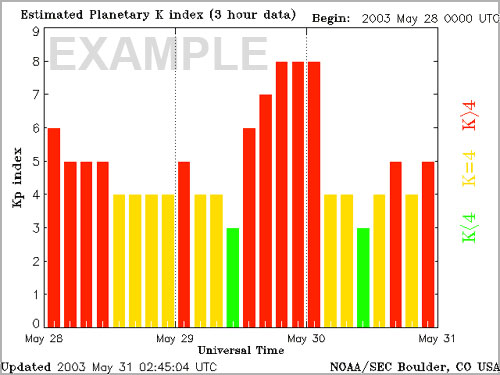

When the aurora kicks up, which is associated with a high Kp, absorption is obviously the problem. We can often work stations within the auroral oval; e..g, UA0 or Scandinavia, but getting to W7 is problematic.

A lot of hams religiously watch the planetary A index, or Ap.  The Ap is a measure of the general level of geomagnetic activity over the globe for a given day. A mean, 3-hourly “equivalent amplitude” of magnetic activity based on K index data is computed from 11 Northern and 2 Southern Hemisphere magnetic observatories between the geomagnetic latitudes of 46 and 63 degrees.  For that reason -- the limit of 63 degrees -- the Ap is less applicable to Fairbanks at 65.5 north geomagnetic.  Even better, data from the College, Alaska, observatory are good real-time indicators of conditions.  See plots at the feed for the College Observatory (CMO).  If you are wondering where Alaska is in the contest, you might have a look at this and NOAA's Space Weather Prediction Center, which has an excellent dashboard for radio users.  Visit https://www.swpc.noaa.gov/communities/radio-communications


Thursday, March 13, 2014

Sked? Look at a Map

I continue to be amused by how clueless some "DXers" are when it comes to trying to work Alaska. Whether for DXCC, WAZ, or just WAS, operators in KL get a lot of requests for scheduled contacts. That's especially true for Alaskan contesters, who are typically the most active. We usually share those requests among ourselves to maximize the chances of a successful QSO.  No matter, though, because some operators just want us to alter the laws of physics as well.

One recent example, which pretty well reflects what I am talking about: "I need Alaska on 160 meters. I am usually active on the band at 8 PM Eastern Time..."  Oh, dude!  There are a couple of things you forgot to consider.  First, 8 PM Eastern time is 4 PM Alaska time.  Second, in mid-March, it is still daylight in Alaska at 4 PM.  In fact, the sun doesn't go down here until nearly 8 o'clock, and it's changing 6-7 minutes each day!

Here are some simple rules of thumb to factor into your propagation "analysis."  In northern hemisphere summer, if it's daylight where you are, it's daylight here.  If it's nighttime where you are, it's daylight here.  In winter, if it's daylight where you are, it's dark here.  If it's nighttime where you are, it's dark here.

We get requests for contacts on 10m:  "Hello, OM.  I badly need Alaska on 10m for 5BDXCC.  I have been hearing many W6 and W7 stations at 1800Z.  I think this should be possible.  73 from Italy!" Maybe, maybe not.  Alaska is BIG.  Really, really BIG.  It covers from about 57 degrees north to 71 degrees north and from about 131 degrees west to 173 degrees west.  Alaska is also far away from everywhere else.  Fairbanks and Anchorage, where most Alaska hams live, are over 1500 miles from Seattle.  That's about the same distance as Boston to Havana!  Hearing stations in W7 or even VE7 has no bearing on whether or not you can work us.

If nothing else, go to the DX Cluster databases and see when and where KL stations are being spotted.  It changes day by day and season to season.  Be flexible.  And above all, be sensible!

Monday, August 16, 2010

NCDXF Beacons: 17 Meters Shows Promise

I have heard Lower 48 hams extol the fun of the 18 MHz band, and I must confess being a bit intrigued.  Several weeks ago I heard a brief European opening in the middle of local night, and I worked a JA at the same time.  Twenty meters was essentially lifeless, and 15m was DOA.  During the solar upset earlier in the month, I was surprised to hear VK/ZL phone transmissions on 17 meters when little could be detected elsewhere.  I decided to download Faros by VE3NEA and spend a few days monitoring the high-band beacon network sponsored by the Northern California DX Foundation.  

The following 24-hour sample shows some surprising (to me) openings on 17 meters.  The vertical axis on each sub-graph represents frequency in MHz.  The horizontal axis shows time starting at 0000Z and major ticks every three hours.  The boxes represent time slots for each beacon, and colors range from dark blue to orange and red to indicate increasing signal strength.  paths are fairly weak.  (Some beacons, like 4U1UN, are off the air.)

Sunday, August 8, 2010

(Almost) All Quiet on the Northern Front

This past week brought a C-class x-ray flare, and the sun sent a coronal mass ejection hurtling toward earth.  The HF prognosis for the first week of August was poor, indeed.  There would be a "solar tsunami" arriving around August 3rd, according to one local headline, while worldwide there were predictions of fantastic auroral displays.  The six-meter gang at the mid-latitudes must have been drooling with anticipation, but HF radio operators inferred a dismal time on the bands.  The HAARP riometer looked grim.  Kp was at 5 and headed upward, plus the aurora scale was pegged at 9.


I would have written off the radio and cleaned the cameras to prepare for the northern lights had it been a week or two later.  The skies at night are still too light to see aurora at 65 North, though.  Instead, I fired up the rig to see what, if anything, I could hear during the onslaught.

I chose to explore 20m around 0200Z, and I heard W1AW with code practice almost ESP-weak.  No other CW signals were audible.  I switched to the 85-foot C3 pointed to Europe, and I noticed  a surprising number of apparently European PSK31 signals.  Although the signals were moderately strong, I could see on the waterfall an unsettling dance of flutter and Doppler.  DM780 could just make out a few prefixes and other tantalizing details.  PSK31 on trans-polar paths is notoriously susceptible to corruption.  I switched to the North American C3 and could begin to see (and decode) several US stations, but copy was still rough. With the Kp index so high, I had little hope of them being able to hear me.  Years of experience have taught me that much.

I quickly scanned the higher bands up through six meters.  I was surprised to hear some weak but readable ZL/VK SSB on 17 meters, but otherwise, they were dead.  Back on 20, I watched the digital waterfall display and saw slightly improving conditions towards the States.  Two very clean PSK signals appeared, which turned out to belong to a VK and a 3D2, both 90-95% readable.  The north-south route was less impacted by the ionospheric turbulence overhead, and I believe grayline enhancement helped things along.  (A short time later I had a nice chat with Aisea 3D2AA and proved the reasonably good path was two-way.)

The signal ID function in DM780 then reported an Olivia 500/16 signal just up the band.  I could barely discern the smeared, faint tones on the waterfall, but I tuned up and changed modes to see what I could monitor.  Lo and behold, it was Peter VE7NBQ having a ragchew with a W5.  Peter had told me of the impressive performance of Olivia earlier in the week, and now I am convinced. As the tones faded from view on my screen, characters continued to print a clean QSO. Olivia's forward error correction makes it far superior to PSK31, and perhaps even CW under some circumstances.  I will have to explore more.

Tuesday, December 15, 2009

Experimenting with Weak Signal Propagation Reporter

Last week, Phil KL8DX mentioned the Weak Signal Propagation Reporter (WSPR) network and the initial success he was having using 8 watts on the low bands from his high-noise location in Healy, near Denali National Park.  G4ILO has a really nice writeup on WSPR.  I couldn't resist the temptation to play myself, so on Friday I configured KL2R to transceive using the K1JT software and report results up to the network.  I changed bands aperiodically from 160/80/40/20 as well as changed antennas.  Here's a map showing spots to/from KL2R during a 16-hour period on 40m using 10 watts and a dipole at 100 feet.

I can see immediately the potential application for contesting to notify the user of possible band openings, particularly on 10 and 160m.  Information on all bands is useful, because propagation from our location to a particular area can be very, very short-lived.  I can also imagine a long-term study using the spot data to better understand conditions required for those openings.  We need more WSPR stations in KL7, since conditions can be highly variable with latitude. 

For the first time in a long time, I am really excited about some new radio technology.