One of the main reasons you haven't heard KL2R much lately is the totally abysmal propagation plaguing us at the high latitudes for months and months. That coupled with a short summer filled with rain, which hindered any attempt to do major station work outdoors. There's still that other tri-bander to get up, a 160 vertical to repair, and 80m vertical system...Oh, and WARC antennas to build. And to boot, we're engaged with the North Pole Contest Group to keep KL7RA on the air, plus upgrades. We've made a few appearances in CW and RTTY contests this winter, but all in all, activity has been very limited.
So let's have a look at a few factors influencing our ability to reach out from the high latitudes. According to my observations in nearly 20 years in Fairbanks. geomagnetic instability results in horribly fickle radio conditions. The planetary K index (Kp) is used to characterize the magnitude of geomagnetic storms. It is measured on a scale of 0 to 9. K-indices of 5 or higher indicate "storm-level" geomagnetic activity. Values of 7 or higher indicate a severe geomagnetic storm. However, when Kp > 3, we at 65 degrees north have one heck of a time getting out. We hear stations, but they often do not hear us. This is particularly true on 20-10 meters. The turbulence in the ionosphere will open the window for a couple of minutes and then shut for many more. On 80 and 160, a Kp of 1 or 0 is acceptable, although such conditions are very rare. The ups and downs are frustrating to say the least. Nevertheless, it teaches patience. The effects are less severe at lower latitudes, even in Anchorage or Kenai, which are near 61 degrees north.
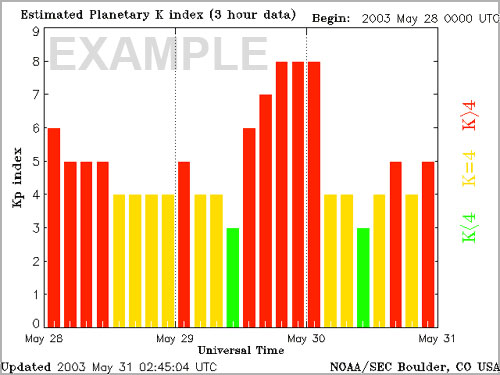
When the aurora kicks up, which is associated with a high Kp, absorption is obviously the problem. We can often work stations within the auroral oval; e..g, UA0 or Scandinavia, but getting to W7 is problematic.
A lot of hams religiously watch the planetary A index, or Ap. The Ap is a measure of the general level of geomagnetic activity over the globe for a given day. A mean, 3-hourly “equivalent amplitude” of magnetic activity based on K index data is computed from 11 Northern and 2 Southern Hemisphere magnetic observatories between the geomagnetic latitudes of 46 and 63 degrees. For that reason -- the limit of 63 degrees -- the Ap is less applicable to Fairbanks at 65.5 north geomagnetic. Even better, data from the College, Alaska, observatory are good real-time indicators of conditions. See plots at the feed for the College Observatory (CMO). If you are wondering where Alaska is in the contest, you might have a look at this and NOAA's Space Weather Prediction Center, which has an excellent dashboard for radio users. Visit https://www.swpc.noaa.gov/communities/radio-communications
So let's have a look at a few factors influencing our ability to reach out from the high latitudes. According to my observations in nearly 20 years in Fairbanks. geomagnetic instability results in horribly fickle radio conditions. The planetary K index (Kp) is used to characterize the magnitude of geomagnetic storms. It is measured on a scale of 0 to 9. K-indices of 5 or higher indicate "storm-level" geomagnetic activity. Values of 7 or higher indicate a severe geomagnetic storm. However, when Kp > 3, we at 65 degrees north have one heck of a time getting out. We hear stations, but they often do not hear us. This is particularly true on 20-10 meters. The turbulence in the ionosphere will open the window for a couple of minutes and then shut for many more. On 80 and 160, a Kp of 1 or 0 is acceptable, although such conditions are very rare. The ups and downs are frustrating to say the least. Nevertheless, it teaches patience. The effects are less severe at lower latitudes, even in Anchorage or Kenai, which are near 61 degrees north.
A lot of hams religiously watch the planetary A index, or Ap. The Ap is a measure of the general level of geomagnetic activity over the globe for a given day. A mean, 3-hourly “equivalent amplitude” of magnetic activity based on K index data is computed from 11 Northern and 2 Southern Hemisphere magnetic observatories between the geomagnetic latitudes of 46 and 63 degrees. For that reason -- the limit of 63 degrees -- the Ap is less applicable to Fairbanks at 65.5 north geomagnetic. Even better, data from the College, Alaska, observatory are good real-time indicators of conditions. See plots at the feed for the College Observatory (CMO). If you are wondering where Alaska is in the contest, you might have a look at this and NOAA's Space Weather Prediction Center, which has an excellent dashboard for radio users. Visit https://www.swpc.noaa.gov/communities/radio-communications


