
Wednesday, February 22, 2017


Where Have All the Signals Gone?
One of the main reasons you haven't heard KL2R much lately is the totally abysmal propagation plaguing us at the high latitudes for months and months. That coupled with a short summer filled with rain, which hindered any attempt to do major station work outdoors. There's still that other tri-bander to get up, a 160 vertical to repair, and 80m vertical system...Oh, and WARC antennas to build. And to boot, we're engaged with the North Pole Contest Group to keep KL7RA on the air, plus upgrades. We've made a few appearances in CW and RTTY contests this winter, but all in all, activity has been very limited.
So let's have a look at a few factors influencing our ability to reach out from the high latitudes. According to my observations in nearly 20 years in Fairbanks. geomagnetic instability results in horribly fickle radio conditions. The planetary K index (Kp) is used to characterize the magnitude of geomagnetic storms. It is measured on a scale of 0 to 9. K-indices of 5 or higher indicate "storm-level" geomagnetic activity. Values of 7 or higher indicate a severe geomagnetic storm. However, when Kp > 3, we at 65 degrees north have one heck of a time getting out. We hear stations, but they often do not hear us. This is particularly true on 20-10 meters. The turbulence in the ionosphere will open the window for a couple of minutes and then shut for many more. On 80 and 160, a Kp of 1 or 0 is acceptable, although such conditions are very rare. The ups and downs are frustrating to say the least. Nevertheless, it teaches patience. The effects are less severe at lower latitudes, even in Anchorage or Kenai, which are near 61 degrees north.
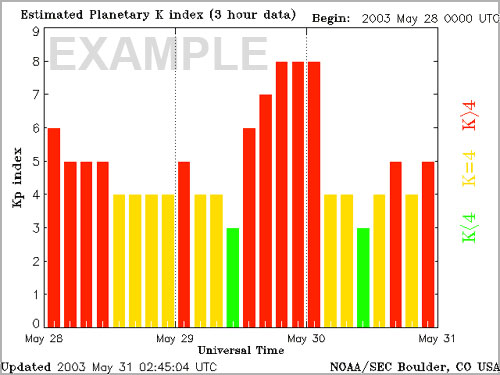
When the aurora kicks up, which is associated with a high Kp, absorption is obviously the problem. We can often work stations within the auroral oval; e..g, UA0 or Scandinavia, but getting to W7 is problematic.
A lot of hams religiously watch the planetary A index, or Ap. The Ap is a measure of the general level of geomagnetic activity over the globe for a given day. A mean, 3-hourly “equivalent amplitude” of magnetic activity based on K index data is computed from 11 Northern and 2 Southern Hemisphere magnetic observatories between the geomagnetic latitudes of 46 and 63 degrees. For that reason -- the limit of 63 degrees -- the Ap is less applicable to Fairbanks at 65.5 north geomagnetic. Even better, data from the College, Alaska, observatory are good real-time indicators of conditions. See plots at the feed for the College Observatory (CMO). If you are wondering where Alaska is in the contest, you might have a look at this and NOAA's Space Weather Prediction Center, which has an excellent dashboard for radio users. Visit https://www.swpc.noaa.gov/communities/radio-communications
So let's have a look at a few factors influencing our ability to reach out from the high latitudes. According to my observations in nearly 20 years in Fairbanks. geomagnetic instability results in horribly fickle radio conditions. The planetary K index (Kp) is used to characterize the magnitude of geomagnetic storms. It is measured on a scale of 0 to 9. K-indices of 5 or higher indicate "storm-level" geomagnetic activity. Values of 7 or higher indicate a severe geomagnetic storm. However, when Kp > 3, we at 65 degrees north have one heck of a time getting out. We hear stations, but they often do not hear us. This is particularly true on 20-10 meters. The turbulence in the ionosphere will open the window for a couple of minutes and then shut for many more. On 80 and 160, a Kp of 1 or 0 is acceptable, although such conditions are very rare. The ups and downs are frustrating to say the least. Nevertheless, it teaches patience. The effects are less severe at lower latitudes, even in Anchorage or Kenai, which are near 61 degrees north.
A lot of hams religiously watch the planetary A index, or Ap. The Ap is a measure of the general level of geomagnetic activity over the globe for a given day. A mean, 3-hourly “equivalent amplitude” of magnetic activity based on K index data is computed from 11 Northern and 2 Southern Hemisphere magnetic observatories between the geomagnetic latitudes of 46 and 63 degrees. For that reason -- the limit of 63 degrees -- the Ap is less applicable to Fairbanks at 65.5 north geomagnetic. Even better, data from the College, Alaska, observatory are good real-time indicators of conditions. See plots at the feed for the College Observatory (CMO). If you are wondering where Alaska is in the contest, you might have a look at this and NOAA's Space Weather Prediction Center, which has an excellent dashboard for radio users. Visit https://www.swpc.noaa.gov/communities/radio-communications
Saturday, July 30, 2016
Saturday, May 7, 2016
The Bucket List
In mid-April I ticked off two items on my bucket list. First, I had business meetings at the Institute for Telecommunication Sciences, the stuff of dreams for me as a lifelong radio geek. The cavernous Building 1 at the Boulder, Colorado, complex has that true science lab feel with long hallways of cinder block and grey metal desks from a bygone era tucked in the countless offices. Book shelves lined with Old School references and unique textbooks wound around the virtual boundaries of personal spaces. That unique, musty aroma of old government buildings permeates the atmosphere. The place just smells like genius. The fundamentals of radio science have been discovered and explored here for decades. (Its organizational predecessor, the Radio Section of the National Bureau of Standards, was founded before World War I.) The trip was capped with a trip to Table Mountain, one of two radio-quiet areas in the US. Ancient antenna dishes stand out like monuments on the prairie. It is a special place for an RF guy like myself.


For many years I had pondered going to the Visalia DX Convention. Last summer I determined to finally make an appearance. I flew from Denver to Fresno (via Seattle and San Diego!), where Ken W6HF and Luci KL1WE met me. We settled in a Tulare hotel a mere 20 minutes from the Visalia Convention Center. One of the most remarkable things about ham radio is that faceless connections you make with people are almost indelible through the years. Finally connecting with the people behind the signals was hugely satisfying, and of course seeing again a number of industry folks for the first time in the 25+ years since I worked at 73 Amateur Radio magazine was a real hoot.
At least among the contesters, the KL2R badge caught immediate attention. They knew the call well. I was struck, however, by the number of people who came up to me and started the conversation with something like, "So do you really live in Alaska, or do you just have a KL call?" To begin talking with a stranger like that implies a lot of cynicism. I guess they've been duped in the past, excited to work a KL only to find soon after the operator lives in the Lower 48, but still...
In the end, I was sorry I had not attended before. The friendships made, renewed, and cinched up enriched me more than I could have imagined. If any of you are reading this blog, THANK YOU! I hope to see you again next year.
At least among the contesters, the KL2R badge caught immediate attention. They knew the call well. I was struck, however, by the number of people who came up to me and started the conversation with something like, "So do you really live in Alaska, or do you just have a KL call?" To begin talking with a stranger like that implies a lot of cynicism. I guess they've been duped in the past, excited to work a KL only to find soon after the operator lives in the Lower 48, but still...
In the end, I was sorry I had not attended before. The friendships made, renewed, and cinched up enriched me more than I could have imagined. If any of you are reading this blog, THANK YOU! I hope to see you again next year.
Tuesday, April 5, 2016
Final Fling with KL7RA
All credits to Wigi AL7IF and Rich's XYL Jyl for supporting one last hoorah for KL7RA on the air.
The team converged on Kenai on Good Friday from literally around the globe. Ed K3PN flew in from South Africa via Denver, in a blizzard. Others converged from points around Alaska to re-connect, make new friendships, and memorialize Rich in the best possible way. Wigi and Angela came down from Anchorage several days before to prepare. The Kenai crew of AL2F, KL2HD, and KL8X were there for the duration, as were KL7SB, WL7BDO, and N1TX. Dan KL1JP flew down from Fairbanks for two hours operating on Saturday, cut short by weather delays. Corliss AL1G showed up noon-ish Sunday and worked the final four hours on 20.
The team converged on Kenai on Good Friday from literally around the globe. Ed K3PN flew in from South Africa via Denver, in a blizzard. Others converged from points around Alaska to re-connect, make new friendships, and memorialize Rich in the best possible way. Wigi and Angela came down from Anchorage several days before to prepare. The Kenai crew of AL2F, KL2HD, and KL8X were there for the duration, as were KL7SB, WL7BDO, and N1TX. Dan KL1JP flew down from Fairbanks for two hours operating on Saturday, cut short by weather delays. Corliss AL1G showed up noon-ish Sunday and worked the final four hours on 20.
You can find Wigi's summary here on 3830: http://3830scores.com/
It pretty well sums up the great emotions we all shared by activating KL7RA one last time.
The gravity didn't really start hitting home with me until 1200Z Sunday. I had avoided focusing on it. I was working the overnight shift with WL7BDO on 20 and chipping away at 160m. Rich was always THE top band guy, and there I was at the position with his hat and glasses in front of me. I answered a call, and another fine op gave me the exchange and said what a wonderful thing it was we were doing.
Then I moved over to 40m. As long as I knew him, Rich had an autographed photo of Joe Rudi NK7U in his Oakland A's uniform, and it was on the wall right in front of me. I heard NK7U around 1400Z and called. It took quite a few times yelling back and forth to finally get through. "KL7?" "KL7A?" back and forth. When he finally got the RA, there was an awkward pause. The band gods cooperated long enough to clear the freq. The op (not Joe) and I had a brief conversation, both of us very, very moved. I fought the tears. I couldn't do anymore and went to bed.
Then I moved over to 40m. As long as I knew him, Rich had an autographed photo of Joe Rudi NK7U in his Oakland A's uniform, and it was on the wall right in front of me. I heard NK7U around 1400Z and called. It took quite a few times yelling back and forth to finally get through. "KL7?" "KL7A?" back and forth. When he finally got the RA, there was an awkward pause. The band gods cooperated long enough to clear the freq. The op (not Joe) and I had a brief conversation, both of us very, very moved. I fought the tears. I couldn't do anymore and went to bed.
After the contest was over, we went upstairs and shared a few Rich stories, then Skyped with Rich's widow Jyl. She was in Indiana. We offered a toast, and let me tell you, there wasn't a dry eye in the house. The remainder of the evening was spent celebrating a remarkable life and legacy. It was a memorial I will never forget.
With Gary AL9A now gone as well as Rich, those of us remaining have more incentive to get KL on the air. There will be no more huge beacon like KL7RA, but we can try to hold a candle in the cold and dark left behind.
Sunday, March 20, 2016
A Tribute to Gary Senesac AL9A SK
The Alaska contester community lost another great one last week. Gary AL9A passed away suddenly while on vacation in Florida. AL9A was a true beacon, often working multiple contests each weekend. According to Carl WL7BDO, in 2015 alone Gary submitted 95 reports to 3830scores.com! He most recently helped with the KL7RST special event. He mentored a number of us, highly skilled in all modes, and particularly knowledgable about Writelog.
He was a kind, generous man and dedicated to his family. He was so proud of his grandchildren and rarely failed to mention them in his correspondence. We send deepest condolences to his clan.
Corliss AL1G put together a video of Gary operating in W1AW/KL7 as part of the ARRL Centennial celebration a couple of years ago:
Wednesday, March 9, 2016
1.5M in ARRL DX SSB
The run up to ARRL DX SSB this year was an exciting one. Compared to 2014, KL2R was largely silent in the multi-op categories for contests in 2015. We did a multi-op in ARRL DX CW during 2015, but it was a marginal effort. A number of factors contributed, chief among them broken and failing equipment. Last fall N1TX resolved to get the station back to multi-2 capability. A new PC for the main position brought the shack to life again. The Shuttle XPC with a 4 GHz i7 CPU, 16 GB RAM, and solid-state drive has no problem keeping up with the multitude of tasks now. It runs Windows 10. Also, the Alpha 89 amplifier, long idle since it became deaf during a brown-out, went off to N4UQ for repair and was returned in perfect working order in February.
KL7SB and WL7F joined N1TX in the shack for ARRL DX CW. It was a good shakedown. We were able to get the "B" position PC going, but it had suffered the same boot problems and unreliability issues for quite some time despite repeated repair attempts. After that contest, it failed hard. With SSB looming within days and more interest in using a second radio to look for multipliers, KL1JP stepped in and donated another zippy PC, which was quickly configured and ready for action.
We have pretty much abandoned Win-Test in favor of N1MM Logger+ over the past year. The latter is very stable and functional now, while WT support languishes and the program seems to be at a dead end. However, I had choice words for N1MM the night before SSB. After an upgrade to the latest version, a cascade of runtime errors proved problematic. They persisted even after a clean re-installation. In the end, I had to rename the old database files, re-install the logger, upgrade it, and then move the old files into the new directory. Heart attack narrowly averted.
Finally, KL2R was ready to go a mere few hours before contest start. It started with a bang on 15 and 20, and just after sunset 40m gained some serious traction by running split. KL stations can run phone between 7075 and 7100 kHz. The FTdx5000MP dual-receive made it so easy to listen for Canadians on our transmit frequency as well as for US hams in the high part of the band. One US ham commented how he'd never had to run such a wide split, which was about 200 kHz. The bottom line is it works for us. We can hear you, and you can hear us.
Sadly, Elaine KL6C was ill and missed the event, but the rest of the gang toughed out up-and-down conditions to score an all-time best for KL2R. Many thanks to KL1BE for being a fantastic hostess again after several years of being out of the game. Good to have you back.

L-R: WL7F, WL7BDO, KL1JP. N1TX not shown.

Subscribe to:
Posts (Atom)