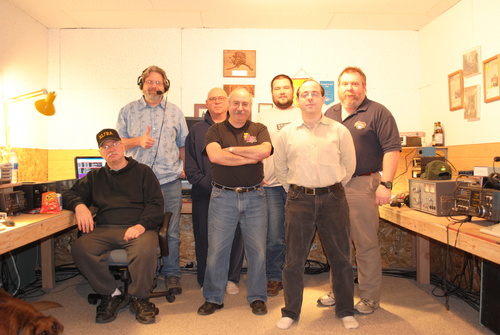
Sunday, November 29, 2009

CQWW CW - Quick Impressions

Conditions seemed, overall, quite decent for KL7 stations.  KL1JP reported incredible propagation using QRP on 80 and 40 meters Friday night.  No 10 meters was obvious in Fairbanks, but 15m proved strong from US/VE and JA.  N1TX took KL2R through the paces solo-band on 20m in low-power unassisted.  The EU C3 tribander proved its worth there. 

Alaska was well represented as a double multiplier for many.  NL7Z, AL9A, AL7R, AL1G, KL8DX, KL1JP, KL2R, and others were on.

Contest         : CQ World Wide DX Contest
Callsign        : KL2R
Mode            : CW
Category        : Single Operator (SO)
Overlay         : ---
Band(s)         : Single band (SB) 20 m
Class           : Low Power (LP) UNASSISTED
Zone/State/...  : 01
Locator         : BP64KU
Operating time  : 15h20

 BAND   QSO  CQ DXC DUP  POINTS   AVG
--------------------------------------
  160     0   0   0   0       0  0.00
   80     0   0   0   0       0  0.00
   40     0   0   0   0       0  0.00
   20   969  27  52  27    2250  2.32
   15     0   0   0   0       0  0.00
   10     0   0   0   0       0  0.00
--------------------------------------
TOTAL   969  27  52  27    2250  2.32
======================================
        TOTAL SCORE : 177 750

Tuesday, November 24, 2009

N1TX: More Impressions of SSB Sweeps


Contest         : ARRL Sweepstakes
Callsign        : KL2R
Mode            : PHONE
Category        : Multi Operator - Single Transmitter (MS)
Overlay         : ---
Band(s)         : All bands (AB)
Class           : Low Power (LP)
Zone/State/...  : AK


Locator         : BP64KU
Operating time  : 14h33

 BAND   QSO DUP SECT  POINTS
-----------------------------
  160     0   0    0       0
   80     3   0    0       6
   40    12   0    1      24
   20   187   1   28     372
   15    92   0   25     184
   10     7   0    5      14
-----------------------------
TOTAL   301   1   59     600
=============================
    TOTAL SCORE : 35 400

Operators       : N1TX, KL1JP, N6PU, WL7GK

Dan KL1JP and Elaine N6PU kicked off Saturday on 10, and shortly thereafter moved to 15 meters to good effect.  Elaine was new to Win-Test, and between that and getting used to the complicated Sweeps exchange, she had a steep learning curve.  However, she soon became expert.  The operators discovered that the cure for calling CQ and getting dead air in return was to have one of them remove their headsets. 

Dan took advantage of the relative heat wave of Saturday afternoon -- it had warmed to -15F -- to try installing a new 160m vertical (rev 2.0), which unfortunately wouldn't tune up.  The MFJ antenna analyzer was cranky in the cold, too.  Dang!

At 1800 local, their shifts were done, so I pressed on 40m for a short while before getting a headache.  After supper, I napped a couple of hours and returned to the airwaves to ply 80/40 to little effect.  I mean, something like 10 QSOs in six hours?  C'MON!

Elaine returned early Sunday morning as 20m was perking up.  Guest operator Bob WL7GK arrived around 0900 local.  He was new to contesting, and Elaine patiently showed him the ropes while I fought a Windoze problem on a rebuilt laptop.  She gave him a good hour tutoring before having to leave again.  Bob caught his stride with S&P, picking up several badly needed sections on 20 and 15m. 

After lunch I finally elbowed my way on to 20m to try to catch a little running.  After a couple of CQs, and operator called me and told me I was QRMing some net and asked me to move a few kHz.  I agreed, but only after I guilted him into giving me an exchange. :-) I also worked W2RCA, a special event station for the Radio Club of America, which was a bonus.

Just after 1600 local I broke 300 QSOs and pulled the plug, completely exhausted but quite pleased with everyone's teamwork. 

We had no equipment problems, save for the 160m antenna situation.  Dan and I are determined to solve the Top Band QSO gap sooner rather than later.

Notice: We have finally signed up with GlobalQSL for confirmation delivery via the bureaus.  Service of everyone's QSL request should be much more responsive.


Sunday, November 22, 2009

ARRL Sweeps SSB - Tough, Fun Learning

I promise not to whine about how lousy the low bands were for us and will focus on the up sides observed here at KL2R.  Elaine N6PU soon developed a knack for keeping 15 meters open until late in the day on Saturday after some brief 10m fun with KL1JP.  N1TX manned the late shift on 40 and 80, and it might as well have a head-banging contest.  Elaine had a late-night work call-out and arrived about 1600Z.  She soon mounted up for some 20m action.  When guest operator Bob WL7GK arrived, she took him under her wing for the basics of operating this contest with Win-Test.  After a little more side-saddle time with Larry, Bob soon found a technique that suited him: S&P.  He netted several badly-needed sections, and I could see a big grin develop from this initial panicked look.

In short, I think we al learned something, both about each other as well as various technologies in the KL2R shack.  It's a training ground, first and foremost.

Monday, November 9, 2009

ARRL CW Sweeps @ KL2R in a Word: UGH!

BAND QSO DUP SECT POINTS
-----------------------------
160   0   0   0   0
80    6   0   0   12
40    48  0   6   96
20    207 1   23  414
15    90  0   32  180
10    0   0   0   0
-----------------------------
TOTAL 351 1   61  702
=============================


TOTAL SCORE : 42,822
Operators :   N1TX, KL1JP

The contest was off to a promising start with a strong opening on 15m, but eventually we moved to 20m and found it was hard to gain traction. Best 40m QSO count ever using the new dipole at 100 feet. Sunday proved rough as the aurora picked up (see purple curve in the chart below), and those east coast multipliers could not hear us.


Tuesday, October 27, 2009

Running KL2R Solo With An Iron Pot On My Head


Larry was gone for the week and upon his return to Alaska, chose to operate at Rich Strand's station KL7RA in Kenai. Larry's absence from Fairbanks and the imminent CQWW SSB contest was enticement enough for me to operate KL2R solo and give those new antennas of his a methodical checkout. My strategy for the contest was to concentrate on acquiring multi's, EU stations and accumulate data on what antenna works the best and for what direction and time period. Little did I know the aurora would kick up into high gear, effectively throwing an iron pot on top of me and that the sun would throw off a nice X-Ray Class C burst adding to a growing list of challenges for my low power operation.


After initializing all the equipment and working out a few start-up bugs, I spent quite a bit of time simply listening…. switching between the Force 12 antennas – the NA C3 and the EU C3. I know that listening in a contest is verboten but heh… I’m testing here. The EU C3 had more noise than the NA C3 but the EU C3 was more sensitive to EU especially Russian and US west coast stations while the NA C3 was more sensitive to daylight JA’s and NA east coast locations. It quickly became obvious that working daylight JA’s off the back of the NA C3 worked better than the EU C3 direct. And, as I expected, China on 20m is still easy during the daytime on the NA C3. I broke thru both large pileups on the first call. Attempting to work the B1/BY3 stations on the EU C3 didn’t bring any results and both calling stations were much muted.


Playing the grayline in the afternoon with the EU C3 got me several stations to the south of Japan and the western coast of Africa (Cape Verde D44AC) to boot. D44AC picked me up on the second call. Tonga (A31KK) came in around the same grayline time period and on the first call. Add to those, both ZM2M and VK4KW which were logged on 15m on the second call. The VK station said we had a big signal.

As I mentioned, during the contest, the aurora kicked up to 9+ and as you would bet, from Fairbanks, the only stations that could hear KL2R where those immediately inside Mother Nature’s iron pot, ie… the aurora cap. Realizing the low probability of contacting lower 48 stations, I altered strategy and attempted to maximize my multi points so I switched to the EU C3 and started calling CQ on both 20m and 15m. Stations in Sweden (SJ2W), Norway (JW7QIA) and Finland (OH8L) came booming back on the first or second call. Surprisingly, even a few in Spain (EB1WW) and (EC2DX) came right back.

Philosophical speaking, having a short lived but high aurora period puts us northern low power stations in good position to pick up EU mults while circumventing the competition. Stations outside the auroral bowl usually have difficulty in being heard by the stations inside the bowl. As long as the aurora is short-lived, it is quite comforting to hear the flutter and realize the competition just dropped out.

In previous contests, the NA C3 usually had difficulty working into JA country during their nighttime. However, the new EU C3 worked exceptionally well into the JA nights on 20m. I had little trouble picking up any existing 20m contacts that I could hear from both JA land and scattered locations within EU. Russian stations RG9A and RZ3AXX came back on the first call. Both reported we had a great signal.


The new 40m dipole was actually disappointing. I expected more EU stations. Generally speaking, I had better luck with the older 40m loop. For example, I was able to get UA0IT on the 40m loop but not on the 40m dipole. The 40m loop is also much quieter and if nothing else, represents an excellent receive antenna. However and surprisingly, the 40m dipole works FB into Alberta and the east coast. I got VE6FI, VE6SV and VE6AO and VA3YP (Ontario) on the dipole – all on the first attempt. I now wonder if the 40m dipole is pointed correctly ? Time to dig out the compass and make some azimuth measurements.


Here in Fairbanks, the 10m band was non-existent. The 15m band was disappointing and full of noise. Usually, 15m contacts from SA were plentiful but not this time. I fought hard for my QSO with LS2D. Both 40m and 80m were disappointing and very noisy, probably due to the high aurora. I made only one contact on 160m and that was one I fought hard for.


Although I spent a lot of time testing, sometimes using one antenna to transmit while receiving on another, I still made 167 QSO’s with 30, 628 total points and was pleasantly surprised I did as well as I did with only 15 hours in the chair (had to work on Sunday).


Dan (KL1JP)


Monday, October 26, 2009

CQWW @ KL7RA

N1TX diverted to Kenai on the way home from DC for a bit of radio action.  Great to have a mini-reunion of some of the old Fairbanks crew from KL7RA, plus some new blood added to the team.  And a good time was had by all. Listen to some 40m audio here.

CQ Worldwide DX Contest, SSB

Call: KL7RA
Operator(s): AL2F AL7IF KA1NCN KL7RA N1TX N5XZ NL7Y
Station: KL7RA

Class: M/M HP
QTH: ALASKA
Operating Time (hrs): 48

Summary:
 Band  QSOs  Zones  Countries
------------------------------
 160:   92     7        6
  80:  341    17       19
  40: 1592    31       71
  20: 3273    35      131
  15: 1525    32       86
  10:   19     7        7
------------------------------
Total: 6872   129      320  Total Score = 7,312,863


KL7RA - N1TX - NL7Y - N5XZ - AL2F - KA1NCN - AL7IF
Photos: KA1NCN

Sunday, October 11, 2009

New Antennas on the Tower...At Last!

The planets aligned, weather moderated, friends and co-workers gathered for a good old-fashioned antenna party at KL2R yesterday. See the KL1JP video (28 MB) here. It's unbelievable how lucky we were. The Force 12 EF-140 40m dipole made it to 100 feet and is oriented to North America and Asia. This should help fill the gaps on 40m, as we go lacking for NA contacts in most contests on this band. The second Force 12 C3 oriented towards Europe is now installed at the 85-foot level and produces superior results. Check out the comparison I did today:

KL2R New Antennas Compared


I don't have enough thanks to offer: KL1RL, KL1JP, N6PU, and my two work colleagues Marc Meindl and Lance Seman.

Good times coming!


Photo by KL1RL